Sales organizations today operate in markets that are:
- Increasingly fast-paced and competitive
- Driven by more informed and demanding customers
- Filled with complex products and solutions that require strong articulation
- Influenced by shifting buying behaviors and digital-first interactions
- Under pressure to deliver predictable, consistent revenue outcomes
Yet many organizations still rely on outdated evaluation methods—such as MCQs, written tests, and generic trainer assessments—that fail to measure the most important aspect of sales readiness: a salesperson’s ability to handle real customer conversations.
Why Scenario-Based Assessments Matter
Traditional assessments fall short because they measure theory, not execution. Scenario-based sales assessments solve this by evaluating real selling behaviors.
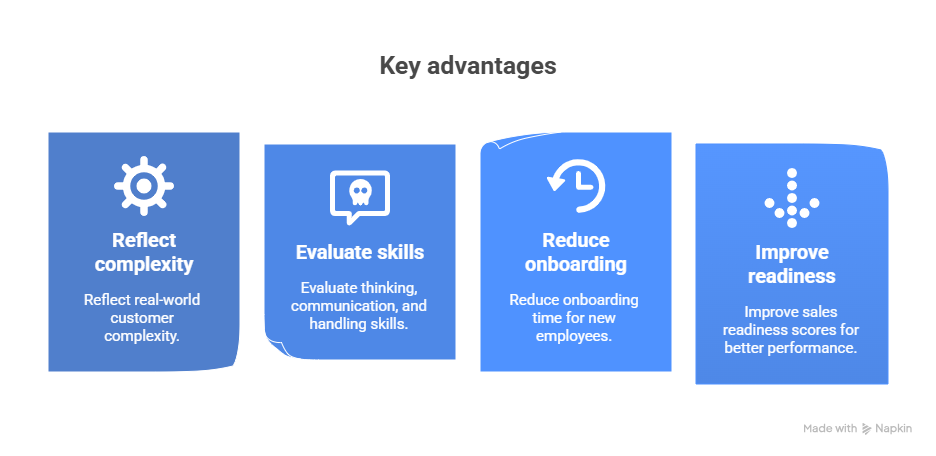
Key advantages include:
- Reflect real-world customer complexity
- Evaluate thinking, communication, and handling skills
- Reduce onboarding time
- Improve sales readiness scores
- Provide consistent and measurable benchmarks
- Identify hidden skill gaps
- Directly influence win rates and customer experiences
This makes scenario-based assessments a core driver of modern sales performance.
Framework for Designing Scenario-Based Sales Assessments
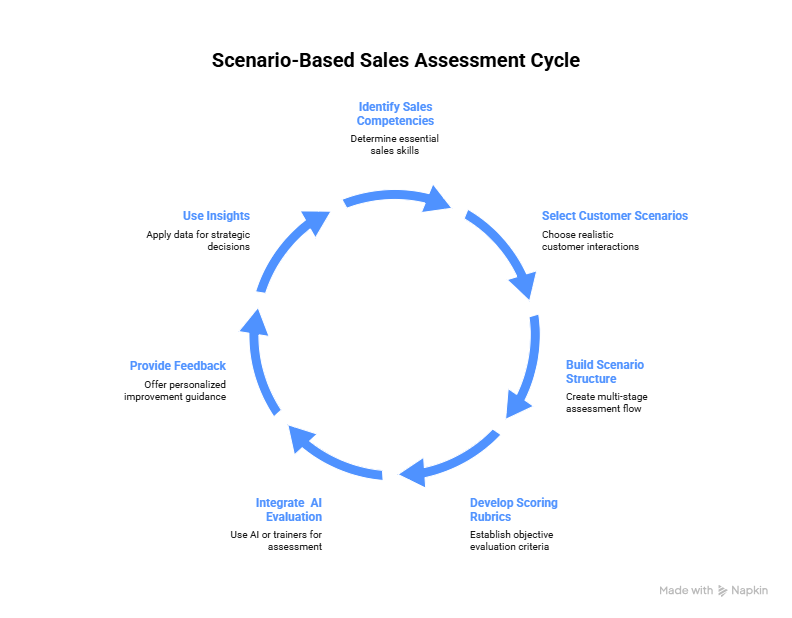
1. Identify Critical Sales Competencies
Start by defining what competencies truly drive performance in your selling motion.
- Discovery questioning
- Handling objections
- Value articulation
- Negotiation skills
- Compliance accuracy
- Product expertise
- Tone, empathy, and customer handling
- Closing skills
2. Select Realistic Customer Scenarios
Your scenarios must reflect conversations that reps genuinely face.
Examples:
- Price objections
- Competitive comparisons
- Customer skepticism about benefits
- Distributor negotiation challenges
- Technical product questions
- Compliance-sensitive discussions
- Demand for unrealistic terms
3. Build a Multi-Stage Scenario Structure
A strong scenario mirrors the natural flow of a customer conversation.
- Opening and rapport building
- Discovery and need assessment
- Customer challenge or pushback
- Handling objections
- Presenting value
- Negotiation
- Closing the conversation
4. Develop Objective, Consistent Scoring Rubrics
Rubrics make assessments measurable and repeatable.
- Clarity and structure of response
- Empathy and acknowledgment
- Accuracy of product or solution explanation
- Quality of objection handling
- Strength of value positioning
- Compliance adherence
- Confidence and tone
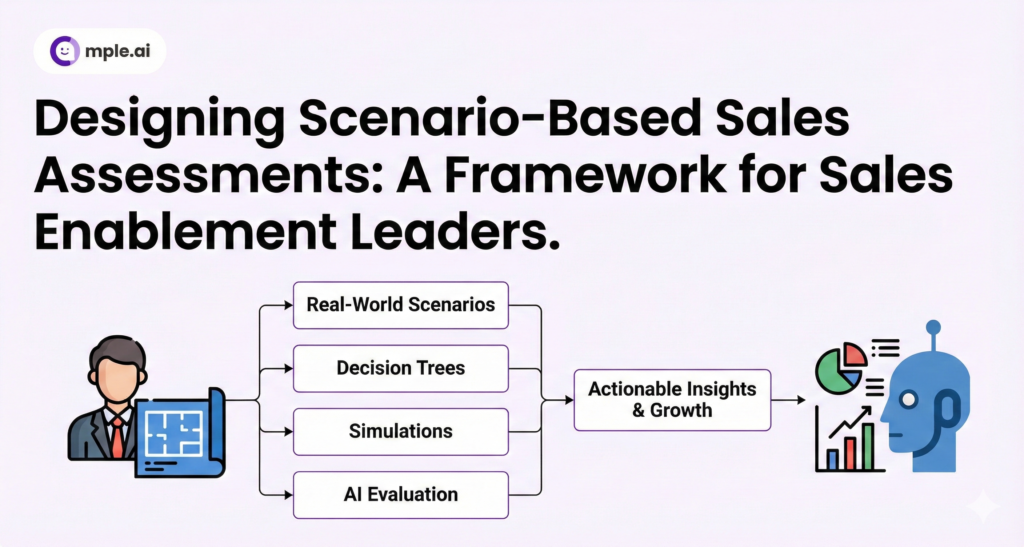
5. Integrate AI or Trainer-Based Evaluation
Modern organizations are moving to AI-driven evaluations because they provide:
- 24/7 availability
- Objective and unbiased scoring
- Instant feedback
- Detailed analysis of tone and delivery
- Scalability across geographies
- Consistent evaluation for every rep
Trainer input remains valuable for market-specific nuances or strategic feedback. A hybrid approach is often the most effective.
6. Provide Personalized Feedback and Remediation Paths
Assessments must not end with scores. They must lead to measurable improvement.
- Specific corrective feedback
- Examples of ideal responses
- Microlearning based on mistakes
- Repeat attempts for practice
- Personalized coaching paths
7. Use Insights for Strategic Decision-Making
Scenario-based assessments produce powerful analytics that help leaders understand:
- Who is truly customer-ready
- Which teams require immediate intervention
- Where specific competency gaps exist
- Which behaviors correlate with higher conversions
- How different markets compare in readiness
- What improvements are needed before product launches
These insights inform hiring, promotions, territory planning, and L&D strategy.
Conclusion
Scenario-based sales assessments transform how organizations evaluate and improve sales talent. They shift the focus from memorized information to real-world capability. They make sales readiness measurable, scalable, and predictable. And they give leaders a consistent, data-driven way to build a high-performance sales culture.
For modern sales enablement leaders, scenario-based assessments are no longer optional. They are a strategic advantage.
Frequently Asked Questions (FAQs)
- Why are scenario-based assessments better than traditional quizzes?They measure how reps behave and respond during real customer conversations rather than testing theoretical knowledge.
- How often should organizations conduct scenario-based assessments?They should be integrated into onboarding, quarterly readiness cycles, pre-launch training, and before deploying reps into the field.
- Are scenario-based assessments applicable beyond sales?Yes. They can be used for customer support, retail teams, field operations, service staff, and distributor-facing roles.
- What criteria should be included in a scoring rubric?Key criteria include objection handling, discovery skills, product accuracy, compliance, tone, and clarity in value articulation.
- Do AI-driven assessments replace human trainers?They complement trainers. AI ensures consistency and scale, while trainers add contextual and strategic insights.
References
- 1. Gartner – “Sales Enablement Benchmarks for 2024”
https://www.gartner.com/en/documents/6028435 - 2. Harvard Business Review – “Why Simulations Lead to Higher Skill Retention”
https://hbr.org/2022/11/using-simulations-to-upskill-employees - 3. Highspot – State of Sales Enablement Report 2025
https://www.highspot.com/resource/state-of-sales-enablement-report-2025/