Since 2022, a silent revolution has transformed insurance sales teams. What was once a field dominated by in-person mentoring and static e-learning is now turning to AI-powered coaching tools—intelligent platforms built to replicate top-tier training at scale.
The catalyst? A post-pandemic workforce that demands speed, personalization, and measurable outcomes.
The global AI in insurance market stood at $4.6 billion in 2022, projected to grow to $79.8 billion by 2032, with a staggering 33% CAGR.
A 2023 McKinsey survey revealed that 77% of insurance firms had adopted AI tools in some capacity—up from 61% the year before.
Platforms offering AI-guided coaching, performance simulation, and behavioral insights aren’t just gaining attention—they’re replacing outdated methods.
But what’s driving this pivot? And more importantly, how are these platforms helping insurance agents—across life, property, and commercial lines—close more deals?
AI Coaching in Insurance: What’s Changed?
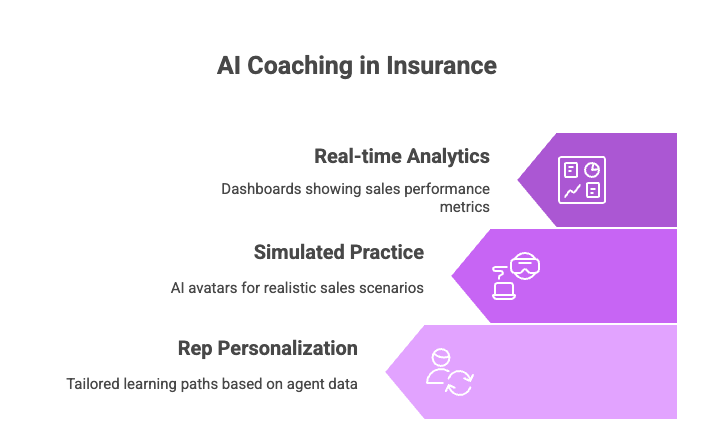
- Rep-Level Personalization: Platforms like Retorio, Mindtickle, and mple.ai use behavioral data to tailor learning paths to each agent’s selling style, strengths, and customer interactions.
- Simulated Practice at Scale: Agents rehearse sales scenarios with AI avatars trained on real objections—impossible with traditional methods at scale.
- Analytics That Surface Sales Patterns: Rather than waiting for quarterly reviews, managers get real-time dashboards showing objection-handling success, talk ratios, and delivery confidence.
These tools don’t replace coaches—they make coaching more dynamic, measurable, and consistent.
What Makes These Tools Useful for Insurance Sales?
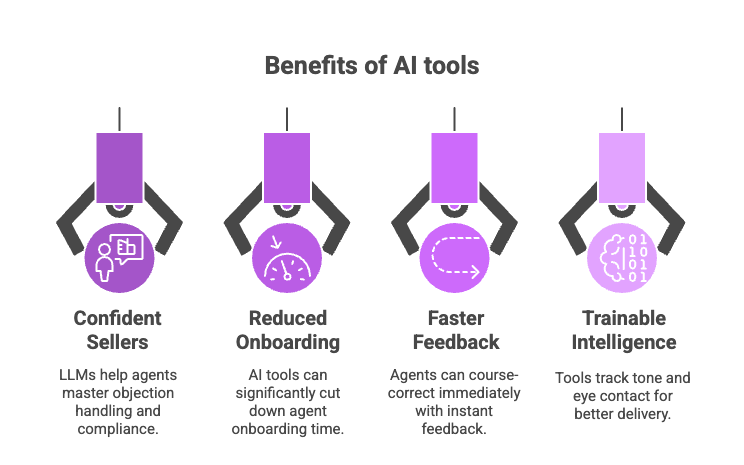
- Complex Products Need Confident Sellers: Agents need to simplify technical products for emotionally-driven buyers. LLM-powered coaching platforms like mple.ai help agents master objection handling, cross-selling cues, and compliance-based language.
- AI Tools Cut Onboarding Time: Example: Trainwell AI helped one InsurTech firm reduce new agent onboarding time by 70%, improving cold outreach results.
- Faster Feedback, Faster Growth: With instant feedback after a mock pitch, agents can course-correct immediately rather than weeks later.
- Emotional Intelligence Becomes Trainable: Some tools now track tone, pauses, and eye contact, helping agents improve trust-building through better delivery.
Why Insurance Enterprises Are Leaning In
Large firms no longer see AI coaching as optional—it’s part of their core tech stack. Here’s why:
- Data-Informed, Not Guess-Based: AI learns from thousands of hours of interactions, helping managers replicate the best performers across teams.
- Cross-Team Knowledge Sharing: AI-captured insights now help sales, claims, and underwriting teams collaborate more effectively.
- Better Compliance, Less Risk: AI platforms can flag regulatory missteps in real-time, reducing oversight costs and legal risks.
Industry Use Cases: Who’s Using It and How
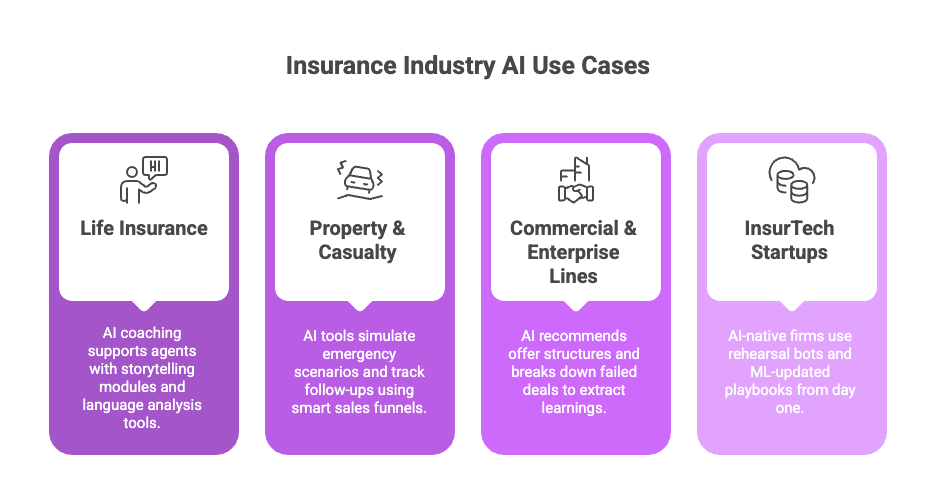
Life Insurance
- Storytelling modules that craft value-driven pitches
- Language analysis tools to flag uncertainty or hesitation
- Example: A U.S.-based life insurer using Retorio increased term policy conversions by 23% in 90 days.
Property & Casualty (P&C)
- Simulating emergency scenarios to improve customer empathy
- Tracking every follow-up and drop-off using smart sales funnels
- Case Study: A top U.S. P&C carrier saw 47% lower churn after using AI bots to improve agent responses during claims.
Commercial & Enterprise Lines
- Recommending offer structures based on deal data
- Breaking down failed deals to extract learnings
- Example: GIC’s in-house AI handled 46% of broker queries independently, accelerating deal cycles.
InsurTech Startups
- Rehearsal bots for email, voice, and chat
- ML-updated playbooks that evolve with customer data
- Result: Lemonade improved lead-to-close rate by 40% after AI-driven feedback was added to onboarding.
Coaching Platforms Insurance Firms Are Turning To
| Platform | Key Feature | Notable Use Case |
|---|---|---|
| mple.ai | Real-time skill reinforcement + personalization | Empowers insurance agents with daily AI-driven coaching and performance feedback |
| Retorio | Video-based behavioral coaching | Simulates life insurance conversations |
| Mindtickle | AI-driven playbooks & gamification | Used by global broker networks |
| Trainwell AI | Virtual avatar-based simulation | Reduced onboarding time by 70% |
| AmplifAI | Contact center coaching | Helped managers cut prep time by 40% |
Common Benefits Observed After AI Coaching Rollout
| Metric | Improvement Range |
|---|---|
| Sales Conversions | ↑ 20–40% |
| Customer Churn | ↓ 15–25% |
| Onboarding Time | ↓ 50–70% |
| Manager Feedback Time | ↓ 30–40% |
Beyond Features: Why Now Is the Time
These aren’t marginal improvements—they’re performance multipliers with measurable ROI.
- Coaching delays = lost revenue: Customers expect faster responses and smarter reps.
- Top talent wants support: Smart coaching platforms make agents feel empowered, not micromanaged.
- Time saved = more selling: Immediate feedback keeps productivity high.
- More importantly, AI doesn’t replace human intuition—it enhances it.
Final Thoughts: Preparing for What’s Next
Insurance companies that invest early in intelligent coaching platforms will lead the pack. These tools help you develop advisors over agents—people who listen, solve, and earn trust.
To Start:
- Run a 90-day pilot with a small sales team
- Choose agent-specific tools like mple.ai
- Prioritize platforms with transparent data ownership
- Track and compare performance metrics regularly
Frequently Asked Questions (FAQs)
Q1: Will AI coaching replace human managers?
A: No. AI enhances a manager’s ability to coach at scale but does not replace human judgment or mentorship.
Q2: How quickly can an insurance firm implement a platform like mple.ai?
A: Most firms can onboard within 2–4 weeks, depending on integration needs and team size.
Q3: Is AI coaching compliant with insurance regulations?
A: Yes, leading platforms include compliance checks and flag risk-prone language during training.
Q4: What types of insurance agents benefit the most from AI coaching?
A: All—life, P&C, and commercial agents benefit, especially those in outbound sales or complex consultative roles.
Q5: How is performance measured after deploying AI coaching?
A: Key metrics include conversion rates, churn, onboarding time, and managerial efficiency—all tracked in real-time dashboards.