AI Chatbot: What It Is, How It Works & Why Enterprises Are Replacing Legacy Systems in 2026
An AI chatbot is no longer a lightweight support tool placed on a website. Inside large organizations, it is becoming a core system for managing conversations, enforcing standards, and guiding actions across sales, service, training, and internal operations.
By 2026, enterprises are replacing legacy systems with AI chatbots because older platforms struggle with fragmented workflows, inconsistent execution, and growing operational effort. This shift is driven by measurable outcomes: better control over conversations, faster execution, and improved business results.
This article explains what an AI chatbot is, how it works in enterprise environments, and why organizations are moving away from legacy systems in favor of conversational AI.
What Is an AI Chatbot?
An AI chatbot is a software system designed to understand human language, identify intent, maintain conversational context, and respond or act using logic and data rather than predefined scripts.
Traditional chat tools depend on rigid flows. AI chatbots adapt to how people actually speak, handle variations in phrasing, and manage multi-step conversations without breaking context.
In enterprise settings, AI chatbots often connect with systems such as CRM platforms, training tools, analytics dashboards, and compliance frameworks. This allows them to guide customers, support employees, and standardize conversations across teams and regions.
- Maintains context across long interactions
- Applies consistent rules across teams
- Integrates with enterprise systems
- Improves through feedback and outcomes
These capabilities move AI chatbots from experimentation to infrastructure.
How AI Chatbots Work in Practice
Enterprise AI chatbots operate through a layered system that turns language into decisions and actions.
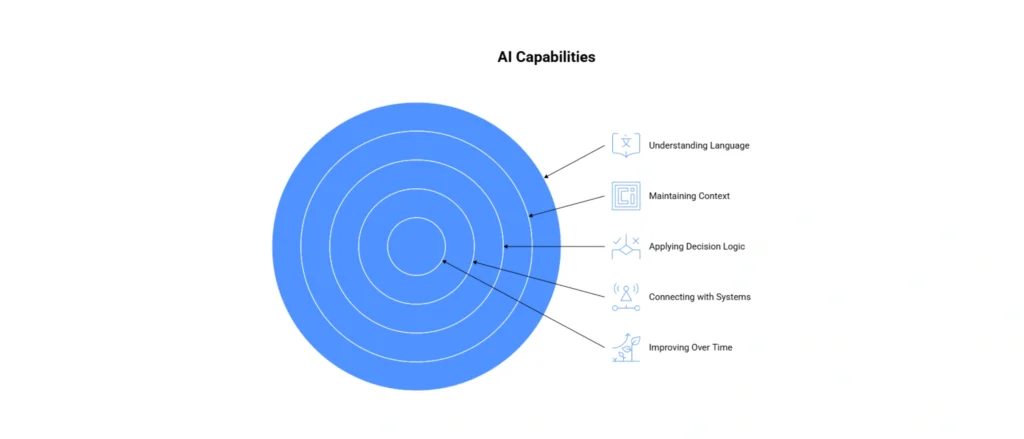
1. Understanding language
User input is processed using natural language processing models. The chatbot focuses on meaning and intent instead of exact wording.
For example, “I need help renewing my policy” and “My policy is expiring soon” are interpreted as the same request.
2. Maintaining context
Enterprise conversations involve follow-ups and clarifications. AI chatbots track context across turns, allowing conversations to progress naturally without repetition.
This is essential for sales discussions, policy explanations, and internal process guidance.
3. Applying decision logic
Once intent and context are identified, the chatbot applies business rules, historical data patterns, and compliance constraints to decide the next action. This could mean answering, asking another question, triggering a workflow, or handing over to a human.
4. Connecting with systems
AI chatbots integrate with internal tools such as CRM systems, knowledge bases, learning platforms, and reporting tools. Conversations lead to actions, not dead ends.
5. Improving over time
Feedback and outcomes are used to refine responses and logic paths. This allows performance to improve as usage increases.
Why Legacy Systems Are No Longer Enough
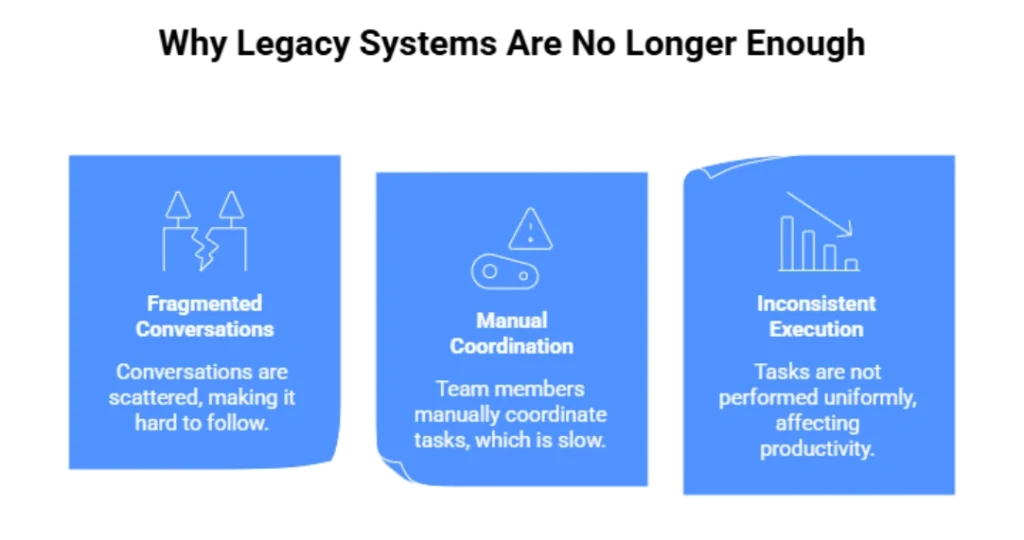
Legacy systems were designed for predictable processes. Enterprise operations today involve high interaction volumes, multiple channels, and frequent changes.
Fragmented conversations
Older systems treat channels separately. Context is lost between email, chat, calls, and internal tools, leading to repeated questions and inconsistent responses.
AI chatbots unify conversations through a single interface.
Manual coordination
Many workflows still depend on people moving information between systems. This increases effort and slows execution.
AI chatbots guide users through steps and trigger actions automatically.
Inconsistent execution
In regulated industries such as insurance, banking, and pharmaceuticals, inconsistent conversations create risk. Different teams interpret scripts and policies differently.
AI chatbots embed standards directly into conversations.
Why Enterprises Are Replacing Legacy Systems with AI Chatbots in 2026
The shift toward AI chatbots is driven by clear operational gains rather than experimentation.
Consistent execution
AI chatbots apply the same logic, guidance, and structure across thousands of conversations, regardless of team or region.
Better use of human effort
Repeatable interactions are handled by the chatbot. Humans focus on exceptions, complex decisions, and relationship-driven work.
Faster control and updates
Changes to policies or workflows can be deployed centrally and reflected immediately across conversations.
Measurable impact
Enterprises report improved conversion rates, reduced training time, stronger compliance adherence, and clearer visibility into conversation quality.
AI Chatbot vs Traditional Chatbots
| Area | Traditional Chatbots | AI Chatbots |
|---|---|---|
| Input handling | Keyword-based | Intent-based |
| Conversation flow | Fixed scripts | Adaptive |
| Context awareness | Limited | Multi-turn |
| Integration | Minimal | Enterprise systems |
| Improvement | Manual updates | Learning-driven |
Operational Impact: Legacy Systems vs AI Chatbots
| Business Area | Legacy Systems | AI Chatbot Approach |
|---|---|---|
| Conversation quality | Varies by individual | Consistent across teams |
| Training effort | Manual and time-heavy | Continuous guided practice |
| Policy adherence | Memory-dependent | Embedded logic |
| Time to insight | Delayed | Immediate visibility |
| Process updates | Slow | Centralized control |
Enterprise Use Cases for AI Chatbots
Sales and lead qualification
AI chatbots guide discovery conversations, ensure key questions are covered, and pass structured information into CRM systems.
Training and coaching
Teams practice conversations through AI-driven simulations and receive consistent feedback. This is where platforms like mple.ai fit naturally, helping enterprises standardize conversations and improve revenue outcomes through AI-based practice.
Customer service
AI chatbots handle high-volume queries, maintain conversation history, and route complex cases with full context.
Internal operations
Employees use AI chatbots to understand policies, complete workflows, and reduce dependency on internal support teams.
AI Chatbot Impact Across Enterprise Functions
| Function | Common Issue | AI Chatbot Contribution |
|---|---|---|
| Sales | Inconsistent discovery | Guided conversations |
| Support | Repeated questions | Context-aware replies |
| Training | Low practice frequency | On-demand simulations |
| Compliance | Script deviation | Built-in guardrails |
| Management | Poor visibility | Conversation insights |
What to Evaluate Before Choosing an Enterprise AI Chatbot
- Ability to handle long, multi-step conversations
- Integration with existing enterprise tools
- Governance and audit controls
- Conversation-level analytics
- Security and compliance readiness
These factors matter more than surface-level features.
FAQ
What is an AI chatbot?
An AI chatbot is a conversational system that understands intent, maintains context, and responds or acts using logic and data.
How is it different from a traditional chatbot?
Traditional chatbots follow scripts. AI chatbots adapt to language, handle complex conversations, and improve through usage.
Can AI chatbots be used in regulated industries?
Yes. Enterprise AI chatbots support audit trails, controlled responses, and policy enforcement.
Do AI chatbots replace humans?
No. They handle repeatable interactions while humans focus on complex decisions.
How do AI chatbots improve revenue?
They guide conversations more effectively, reduce errors, and shorten training cycles.
Final Takeaway
AI chatbots in 2026 represent a structural change in how enterprises manage conversations, decisions, and execution. They replace fragmented tools with a conversational layer that understands intent, maintains context, and enforces consistency.
Legacy systems were built for a different operating model. Enterprises adopting AI chatbots are addressing real problems tied to execution quality, operational effort, and revenue performance.
References
- Gartner – Conversational AI insights
- McKinsey & Company – AI productivity research
- IBM Research – Conversational AI systems