
Sales teams today face a paradox. They have more tools, data, and channels than ever before—yet sales cycles are longer, buyer expectations are higher, and consistency across reps is harder to achieve.
This is where AI in sales teams is no longer optional. AI has shifted from being a productivity enhancer to becoming a core driver of sales readiness, coaching, and revenue outcomes.
In this blog, we explore the role of AI in sales teams, real-world use cases, measurable impact, implementation best practices, and how AI sales coaching platforms like mple.ai are reshaping modern sales enablement.
Why AI Is Becoming Critical for Modern Sales Teams
Traditional sales enablement relies heavily on:Traditional sales enablement often depends on one-time training sessions, static playbooks, and manager-led coaching that varies widely in quality and consistency, while success is measured using lagging indicators like quarterly revenue numbers—leaving little visibility into real, in-conversation selling skills or day-to-day readiness.
AI changes this by introducing continuous, data-driven enablement.
My perspective: The biggest value of AI in sales isn’t automation—it’s behavior change at scale. When AI continuously observes, simulates, evaluates, and coaches reps, sales performance becomes predictable instead of reactive.
How AI Transforms Sales Teams: Practical Impact
| Sales Challenge | How AI Helps | Impact on Sales Teams |
|---|---|---|
| Long onboarding and ramp-up time | AI-driven coaching, simulations, and personalized learning paths | Faster readiness, consistent onboarding across regions |
| Inconsistent sales conversations | AI roleplays simulate real buyers and objections | Higher confidence and uniform messaging |
| Weak objection handling | AI identifies response gaps and suggests better talk tracks | Improved win rates and deal progression |
| Manual and biased coaching | Automated, data-backed feedback for every rep | Fair, scalable, and continuous coaching |
Key Roles of AI in High-Performing Sales Teams
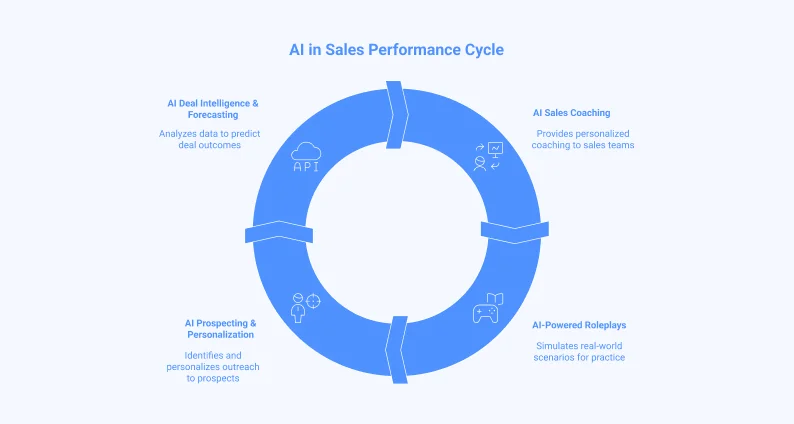
1. AI Sales Coaching & Continuous Enablement
AI-powered sales coaching replaces one-size-fits-all training with personalized learning paths. Reps receive:
AI-powered sales coaching replaces one-size-fits-all training with personalized learning paths, where reps receive real-time feedback, skill-level benchmarking, and targeted coaching recommendations—ensuring consistent, unbiased development for every seller, not just
This is the foundation of platforms like mple.ai sales coaching platforms that focus on readiness, not just activity.
2. AI-Powered Roleplays for Real-World Readiness
One of the most impactful roles of AI in sales teams is realistic roleplay simulation, where AI-powered roleplays allow reps to practice objection handling, simulate difficult buyer personas, train for regulated or high-stakes conversations, and repeat scenarios without relying on managers—making this especially powerful for industries like pharma, BFSI, insurance, and enterprise SaaS, where every conversation must carefully balance persuasion, compliance, and accuracy.
mple.ai’s roleplay feature ensures reps don’t learn on real customers—by enabling safe, repeatable practice of high-stakes conversations before they happen in the field.
Personal view: Roleplays are where AI delivers its highest ROI. Sales reps don’t fail due to lack of knowledge—they fail due to lack of practice.
3. AI in Sales Prospecting & Personalization
AI helps sales teams move from generic outreach to context-aware personalization by analyzing past deal data, identifying winning talk tracks, and suggesting messaging based on real buyer signals. This allows reps to approach prospects with relevant, timely communication instead of relying on assumptions or mass templates.
As a result, teams spend far less time on manual research while seeing measurable improvements in open rates, reply rates, and meeting conversions. Importantly, AI doesn’t replace the rep’s voice—it sharpens it, helping sellers sound more informed, confident, and human in every interaction.
This reduces time spent on manual research and improves:
4. AI Deal Intelligence & Forecasting
AI continuously analyzes CRM data, call transcripts, and buyer engagement signals to create a real-time view of deal health across the pipeline. Instead of relying solely on gut feel or delayed reports, sales leaders gain early visibility into what’s actually happening in customer conversations.
By doing so, AI flags at-risk deals, stalled opportunities, and coaching gaps that are directly impacting pipeline performance—enabling timely intervention, focused coaching, and more predictable revenue outcomes.
For managers, this means moving from intuition-led reviews to evidence-backed coaching conversations.
How to Implement AI in Sales Teams Successfully
Many AI initiatives fail due to poor implementation, not poor technology. Here’s what works:
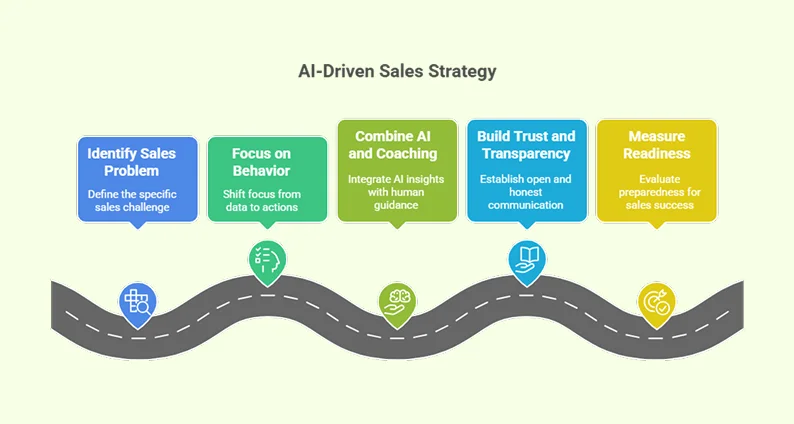
1. Start with a clear sales problem
Common sales challenges include long ramp times for new reps, weak objection handling in live conversations, and inconsistent discovery calls that lead to poor qualification and unpredictable outcomes.
2. Focus on behavior, not dashboards
Adoption matters less than behavioral change.
3. Combine AI insights with human coaching
AI surfaces gaps; managers reinforce outcomes.
4. Build trust and transparency
Sales reps adopt AI faster when feedback is explainable and fair.
5. Measure readiness, not just revenue
Track skills, conversations, and confidence—not only numbers.
This is where AI sales enablement platforms like mple.ai stand out—by connecting coaching directly to performance.
| Sales Metric | Before AI Adoption | After AI Adoption | What Changed |
|---|---|---|---|
| Sales rep ramp-up time | 4–6 months | 2–3 months | AI coaching and roleplays accelerated readiness |
| Win rate | 18–22% | 25–30% | Better objection handling and discovery quality |
| Time spent on non-selling tasks | 35–40% of rep time | 15–20% of rep time | AI automation and insights reduced manual work |
| Objection-handling success | Inconsistent across reps | Standardized, repeatable responses | AI roleplays reinforced best practices |
How mple.ai Enables AI-Driven Sales Coaching
mple.ai is built to address the exact gaps modern sales teams face:
- AI-powered roleplays that feel like real customers
- Automated evaluations of sales conversations
- Continuous coaching without manager overload
- Performance analytics tied to real skills
Instead of generic training, mple.ai focuses on sales readiness, conversation quality, and measurable outcomes.
Learn more about Sales enablement with AI.
Final Thoughts: AI Is the Sales Multiplier of This Decade
The role of AI in sales teams is no longer about experimentation—it’s about execution.
AI doesn’t replace great salespeople.
It creates more of them.
Teams that combine AI sales coaching, realistic roleplays, and actionable analytics will outpace competitors who still rely on static training and intuition-led management.
If your goal is predictable revenue and consistently high-performing sales teams, AI is no longer a “future investment”—it’s a present advantage.
FAQs: AI in Sales Teams
1. Will AI replace sales reps?
No. AI augments sales reps by automating low-value tasks and strengthening skills. Relationship-building and trust remain human-led.
2. How quickly can sales teams see ROI from AI?
Early productivity gains appear within 1–3 months. Revenue impact typically follows within 3–6 months.
3. Is AI suitable for regulated industries like pharma or BFSI?
Yes. AI roleplays are especially effective for compliance-heavy industries when built with domain guardrails.
4. What metrics should leaders track?
Ramp time, win rate, objection-handling quality, roleplay scores, and conversion consistency—not just activity volume.