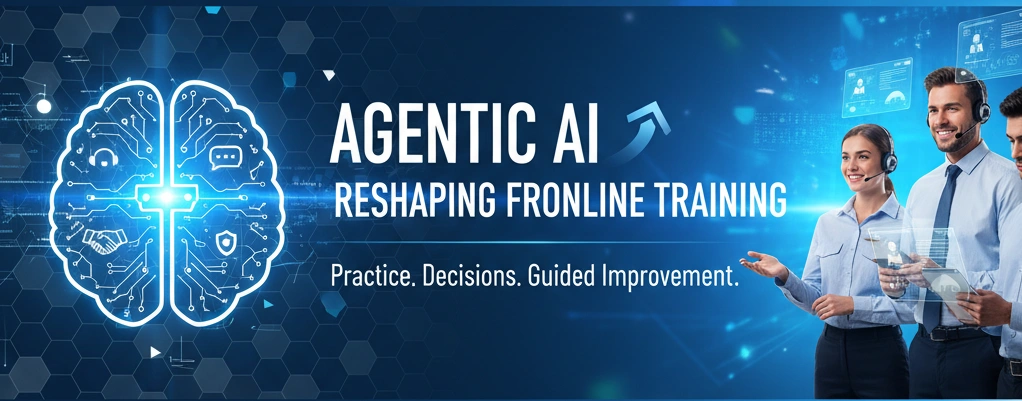
Frontline employees operate where expectations are highest and margin for error is smallest. A single interaction can decide customer trust, revenue, or compliance risk. Despite this, frontline training still relies heavily on static modules, infrequent role-plays, and delayed feedback.
Agentic AI introduces a different training model, one built around practice, decision-making, and guided improvement rather than content completion. This shift is reshaping how organizations prepare frontline teams for real customer situations.
This article explains what agentic AI means in the context of frontline training, why it matters now, how it differs from existing AI-based learning tools, and what organizations should measure when adopting it.
What Is Agentic AI in Frontline Training?
Agentic AI refers to AI systems that can act toward a goal, make decisions during interactions, observe outcomes, and adjust behaviour within defined boundaries.
In frontline training, this means the AI does more than:
- Deliver learning content
- Score responses
- Recommend next modules
Instead, it participates in the learning process by:
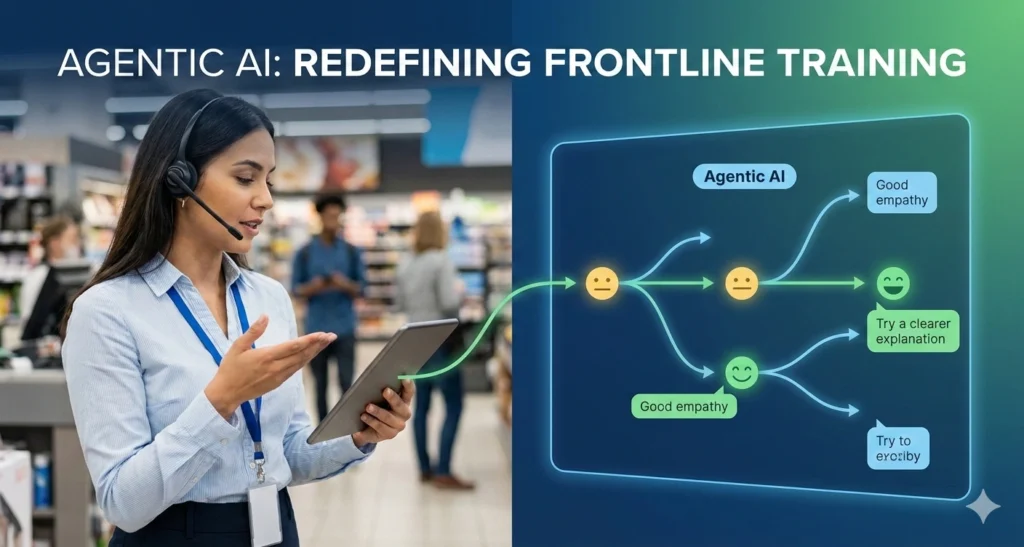
- Running conversations
- Responding to employee decisions
- Changing scenarios based on performance
- Guiding repeated practice until competence improves
The learner is no longer navigating static training paths. The training adapts to how the learner behaves.
Why Frontline Training Needs a Different Approach
Most frontline roles share constraints such as limited time for training, high variability in customer behaviour, pressure to perform from day one, and managers stretched across operations.
Common gaps in frontline training:
- Practice is rare and inconsistent
- Feedback arrives after mistakes occur with customers
- Role-plays depend on manager availability
- Training content fails to reflect real situations
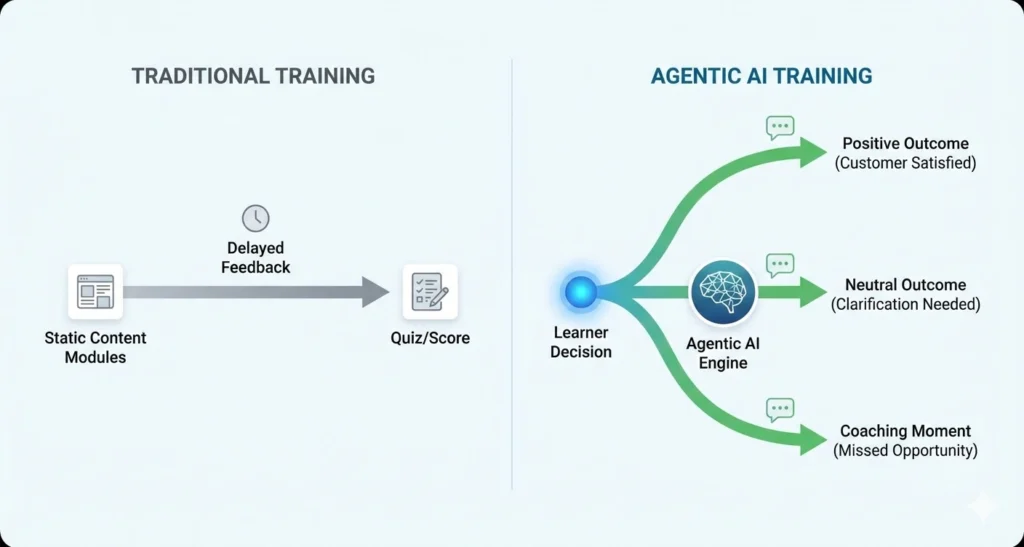
How Agentic AI Changes Frontline Training
1. Decision-Based Practice Instead of Content Consumption
Agentic AI places learners inside scenarios where each choice affects the outcome.
2. Continuous Practice Without Operational Disruption
Employees can engage in short, high-value practice sessions (5-10 minutes) without needing to be pulled off the floor for hours.
3. Feedback That Focuses on Behaviour
Instead of generic scores, agentic AI highlights missed intent, weak objection handling, scripted language, and compliance cues.
4. Exposure to Variation and Pressure
Agentic AI introduces variability such as customer mood changes, time constraints, conflicting priorities, and policy limitations.
Frontline Training Challenges vs Agentic AI Outcomes
| Training Challenge | Impact on Teams | Agentic AI Outcome |
|---|---|---|
| Limited practice time | Poor readiness | Frequent guided practice |
| Delayed feedback | Repeated mistakes | Immediate corrective guidance |
| Static role-plays | Low realism | Scenario variation |
| Manager dependency | Training bottlenecks | Self-directed practice |
| Generic modules | Low engagement | Behaviour-based adaptation |
Agentic AI vs Traditional AI Training Tools
| Dimension | Traditional AI Training | Agentic AI Training |
|---|---|---|
| AI role | Content delivery | Active participant |
| Interaction flow | Predefined | Context-aware |
| Learner control | Navigation-based | Decision-based |
| Feedback timing | After completion | During and after practice |
| Skill development | Periodic | Ongoing |
Metrics Organizations Track When Using Agentic AI
- Time to role readiness
- Practice frequency per employee
- Reduction in repeated errors
- Reduction in trainer-led sessions
- Coaching hours saved
- Improvement in customer interaction quality
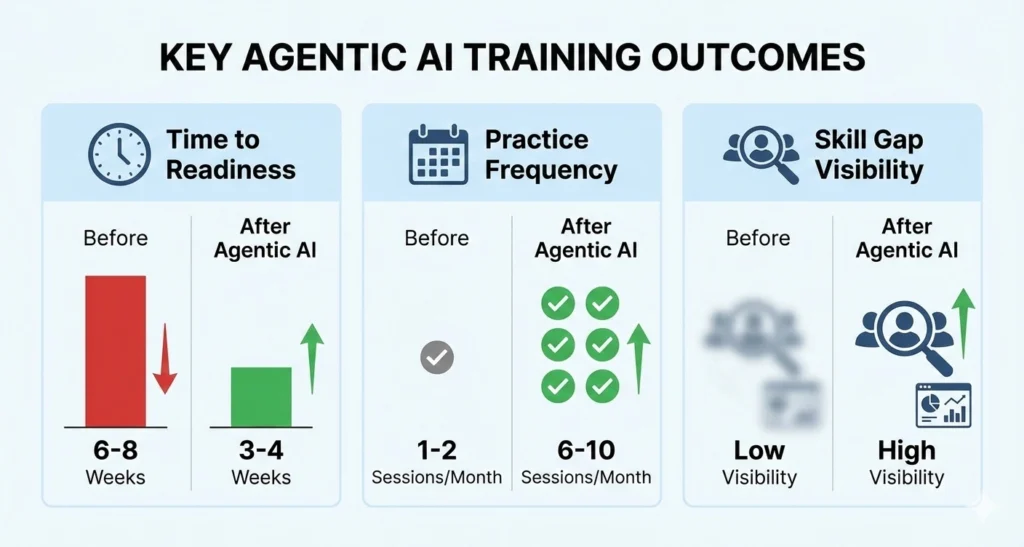
Indicative Before-and-After Metrics
| Metric | Before | After |
|---|---|---|
| Practice sessions/month | 1–2 | 6–10 |
| Time to readiness | 6–8 weeks | 3–4 weeks |
| Manager coaching hours | High | Lower |
| Scenario coverage | Limited | Broad |
| Skill gap visibility | Low | High |
The Path Forward
Frontline training is moving away from episodic instruction toward continuous skill development. Agentic AI supports this shift by embedding guided practice into everyday workflows.
Frequently Asked Questions
1. What makes agentic AI different from traditional AI training tools?
Agentic AI guides practice by responding to learner decisions and adjusting scenarios rather than delivering fixed content.
2. Which frontline roles benefit most from agentic AI training?
Customer-facing roles such as retail staff, sales teams, support agents, and service professionals benefit most.
3. How quickly can organizations see results?
Many organizations observe changes in practice frequency and readiness within weeks, depending on adoption.
4. Does agentic AI replace human trainers?
No. It reduces repetitive coaching tasks and allows trainers to focus on mentoring and performance improvement.
5. Is agentic AI suitable for compliance-sensitive environments?
Yes, when designed with defined boundaries and oversight, it supports compliant behaviour through guided practice.