Corporate training has a credibility gap. Employees complete courses and assessments, yet managers still notice inconsistent performance when real work begins. The issue is rarely effort. It is that most training programs measure participation rather than capability.
Artificial intelligence is changing how organizations approach learning by shifting focus from content delivery to skill application, feedback quality, and outcome tracking. Instead of asking whether employees finished training, leaders can now see whether training changed behavior.
This article explains how AI is used in corporate training, the practical benefits it delivers, real examples across roles, and how organizations can calculate ROI with clarity rather than assumptions.
Why Traditional Corporate Training Often Misses Impact
Many corporate training programs struggle because they rely on static formats. Employees move through the same modules regardless of experience or role, and success is often defined by completion rates. Feedback arrives late, evaluations depend heavily on trainer interpretation, and leadership teams lack visibility into whether learning improves performance.
The result is predictable. Training happens, but confidence, consistency, and execution vary widely across teams. AI addresses this gap by anchoring learning to practice and measurable improvement rather than attendance.
What AI in Corporate Training Really Means
AI in corporate training refers to using machine learning and language-based systems to evaluate how employees perform during training activities and to guide improvement. It does not replace instructors or managers. It strengthens their ability to coach and measure progress.
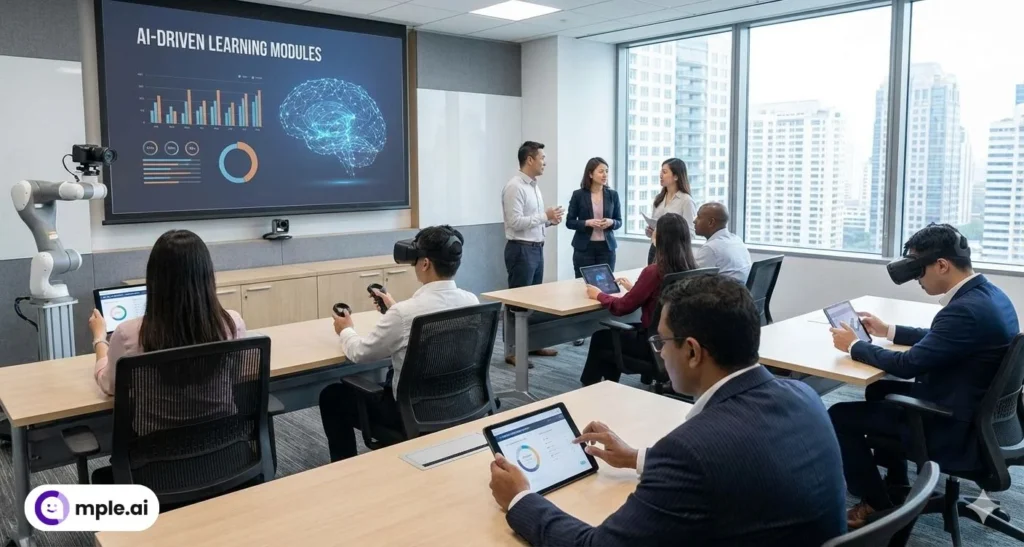
In practice, AI enables adaptive learning paths, simulated workplace scenarios, automated evaluation of responses, and data-driven coaching recommendations. Training evolves based on how an employee performs, not on a fixed curriculum.
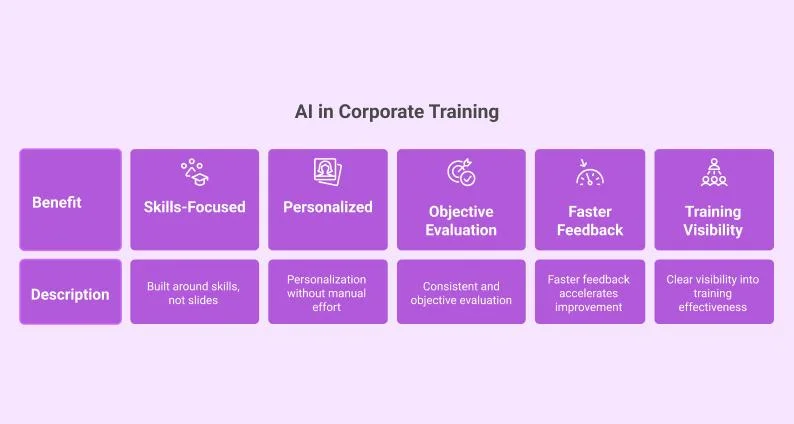
Training Built Around Skills, Not Slides
AI-driven training emphasizes doing rather than watching. Employees practice conversations, decisions, or workflows in simulated environments. This approach builds confidence faster and improves retention because learners apply knowledge immediately.
For roles involving customer interaction, regulatory judgment, or complex explanations, this shift from theory to execution makes a measurable difference.
Personalization Without Extra Manual Effort
AI evaluates performance continuously and adjusts training focus automatically. Employees spend more time practicing areas where they struggle and less time repeating what they already know. This happens without trainers manually assigning paths or reviewing every interaction.
Learning teams gain personalization without increasing operational workload.
Consistent and Objective Evaluation
Human-led assessments vary across trainers and locations. AI applies the same criteria to every learner, making evaluations fair and comparable. This consistency helps organizations identify true skill gaps and benchmark performance accurately.
Faster Feedback That Accelerates Improvement
Feedback delivered immediately after practice helps employees correct mistakes while the experience is still fresh. Instead of waiting days for review, learners receive clear guidance on what worked and what needs improvement.
Clear Visibility Into Training Effectiveness
AI-powered training generates insights that go beyond completion data. Leaders can see patterns such as recurring mistakes, skills linked to strong performance, and early indicators of underperformance.
For deeper context on how organizations track skill application instead of attendance, this resource on measuring behavioral change with AI is relevant.
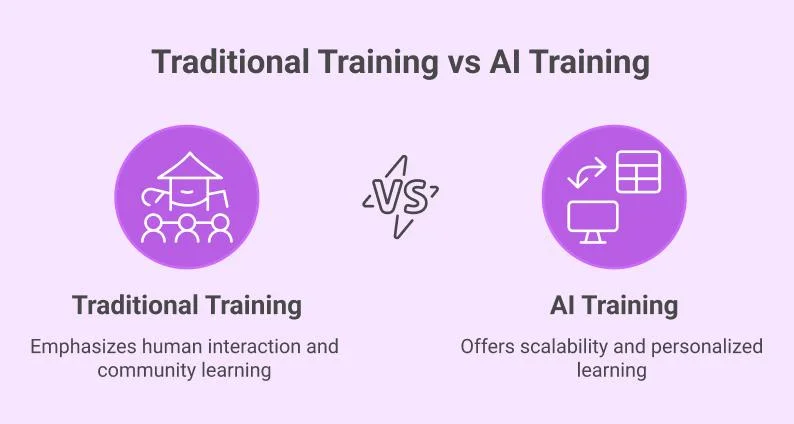
Traditional Training vs AI-Driven Training
| Area of Comparison | Traditional Corporate Training | AI-Driven Corporate Training |
|---|---|---|
| Learning focus | Knowledge transfer | Skill application |
| Content flow | Fixed curriculum | Adapts based on performance |
| Feedback timing | Delayed | Immediate |
| Evaluation method | Trainer-led | Automated and consistent |
| Performance visibility | Limited | High |
| Link to business outcomes | Indirect | Direct and measurable |
This shift explains why AI-led programs tend to show faster and more reliable performance improvement.
Real-World Examples of AI in Corporate Training
Sales and customer-facing teams use AI roleplays to practice real conversations. These simulations cover discovery, objection handling, and product explanations, with feedback on clarity, accuracy, and confidence. Organizations often see quicker onboarding and more consistent communication.
In compliance-heavy functions such as banking, insurance, and healthcare, AI scenarios test judgment and decision-making rather than memorization. Employees are evaluated on how they respond under pressure, which mirrors real-world risk situations.
Leadership training also benefits from AI environments. Managers rehearse performance feedback or conflict discussions and receive structured guidance without risking real employee relationships.
Customer support teams use AI scenarios to practice escalations and policy discussions, improving resolution quality while reducing reliance on shadowing.
Measuring ROI of AI in Corporate Training
AI makes training ROI easier to evaluate because learning activity is directly linked to performance outcomes.
Organizations typically measure impact across onboarding speed, role-specific performance metrics, retraining costs, attrition, and manager productivity. Unlike traditional programs, these metrics are observable and comparable over time.
For outcome-based benchmarks and real figures, this article on AI ROI in sales training shows how learning improvements translate into business results.
Key ROI Metrics and What They Indicate
| Metric | What It Measures | Why It Matters |
|---|---|---|
| Time to competency | Speed at which employees reach expected performance | Faster productivity and lower onboarding cost |
| Performance accuracy | Quality of decisions or responses | Reduced errors and rework |
| Conversion or resolution rate | Effectiveness in customer-facing roles | Direct revenue or service impact |
| Retraining frequency | Need for repeat training | Lower training spend |
| Attrition rate | Employee retention | Reduced hiring and replacement costs |
| Manager coaching time | Time spent on manual reviews | Higher leadership efficiency |
Many organizations see positive ROI within the first year once these indicators begin to move.
Final Takeaway
AI in corporate training works when it strengthens real job behavior rather than delivering more content. By focusing on practice, immediate feedback, and measurable outcomes, organizations gain clarity into what training actually achieves.
For leaders under pressure to justify learning investments, AI offers something traditional approaches rarely provide: clear proof that training improves performance.
Frequently Asked Questions (FAQs)
Is AI suitable for all types of corporate training?
AI is most effective in training that involves communication, judgment, compliance, or customer interaction. Its value is strongest where behavior and decision quality matter.
Does AI replace trainers or managers?
No. AI supports trainers and managers by handling evaluation and insight generation. Human expertise remains essential for coaching and leadership development.
How quickly can organizations see results?
Many organizations observe improvements within a few months, particularly in onboarding speed and consistency. Full ROI is often visible within a year.
Is AI-based training difficult to implement?
Most organizations begin with focused pilots. A targeted rollout tied to clear outcomes reduces complexity and speeds adoption.
How does AI ensure fair evaluation?
AI applies the same criteria to every learner, reducing subjectivity and inconsistency across teams and locations.
References
- McKinsey & Company: AI in the workplace – Superagency in the Workplace
- Harvard Business Review: AI is changing how we learn at work – HBR Article
- World Economic Forum: Skills development is critical to bridging the global digital talent gap – WEF Article