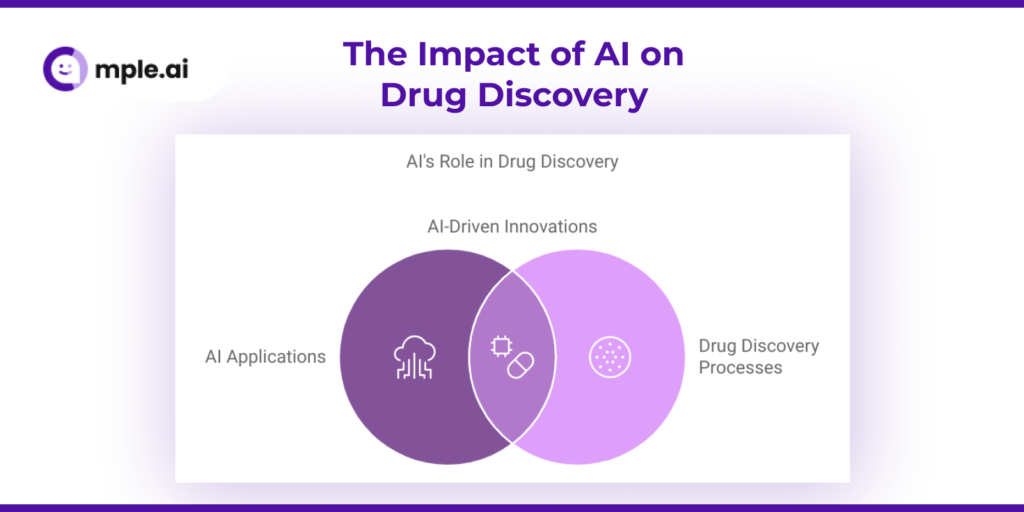
The pharmaceutical industry is undergoing a significant transformation, thanks to the advent of artificial intelligence (AI). AI is not only accelerating the traditionally time-consuming and costly drug discovery process but also opening doors to innovative methods that were previously unimaginable. From identifying potential drug targets to optimizing lead compounds, AI is reshaping the future of medicine.
What You’ll Learn
By the end of this blog, you’ll understand:
- The challenges in traditional drug discovery and how AI addresses them.
- Key AI applications in various stages of drug discovery.
- Real-world examples of AI-driven breakthroughs in pharmaceuticals.
- The benefits and limitations of using AI in drug development.
Challenges in Traditional Drug Discovery
Developing a new drug is a complex and expensive process, often taking 10-15 years and billions of dollars to bring a single drug to market. Key challenges include:
- High Failure Rates: A vast majority of drug candidates fail during clinical trials due to efficacy or safety issues.
- Time-Consuming Processes: Identifying viable drug targets and optimizing compounds require years of research.
- Limited Data Utilization: Traditional methods struggle to process and analyze the vast amount of biomedical data available today.
- High Costs: The cost of failed experiments and extended timelines significantly inflates drug development expenses.
How AI is Revolutionizing Drug Discovery
AI offers transformative potential across various stages of drug discovery, enabling faster, more accurate, and cost-effective solutions. Below are some key applications:
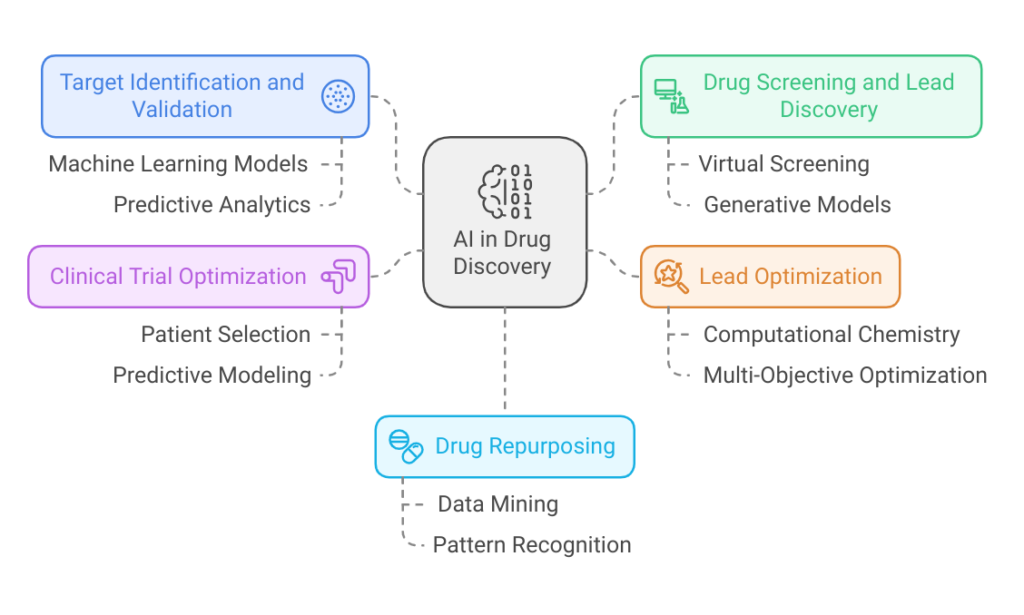
- Target Identification and Validation: AI analyzes vast datasets from genomics and proteomics to identify biological targets for new drugs. Methods include:
- Machine learning models analyze patterns in genetic and clinical data to pinpoint disease-associated targets.
- Predictive analytics assess the likelihood of a target’s druggability and its role in specific diseases.
- Drug Screening and Lead Discovery: High-throughput virtual screening powered by AI accelerates the process of identifying promising compounds from vast chemical libraries. Methods include:
- Virtual screening predicts how molecules interact with targets, narrowing down viable candidates.
- Generative models, such as GANs, design novel compounds with optimized properties.
- Lead Optimization: AI fine-tunes lead compounds by predicting modifications that enhance efficacy and safety through:
- Computational chemistry simulates molecular interactions to refine compound structures.
- Multi-objective optimization balances parameters like potency, solubility, and toxicity.
- Clinical Trial Optimization: AI improves trial efficiency by analyzing patient data for suitable participants and using predictive modeling to design better studies.
- Drug Repurposing: AI accelerates identifying new uses for existing drugs by mining clinical and molecular data for hidden correlations.
Real-World Success Stories
Several companies and research institutions have demonstrated AI’s impact on drug discovery:
- Insilico Medicine: Developed a potential treatment for pulmonary fibrosis in less than 18 months using AI-driven target identification and molecule design.
- Exscientia: Created a drug candidate for obsessive-compulsive disorder that entered clinical trials in record time.
- DeepMind’s AlphaFold: Revolutionized protein structure prediction, providing critical insights for drug design.
Benefits of AI in Drug Discovery
AI offers numerous advantages in drug discovery, including:
- Reduced Time and Costs: Accelerates the identification and optimization of drug candidates.
- Improved Accuracy: Analyzes vast datasets with unparalleled precision, reducing the risk of failure.
- Enhanced Innovation: Enables the discovery of novel targets and compounds.
- Personalized Medicine: Facilitates the development of therapies tailored to individual genetic profiles.
Limitations and Challenges
Despite its promise, AI faces several hurdles in drug discovery:
- Data Quality and Availability: AI models require high-quality, comprehensive datasets, which are not always accessible.
- Complexity of Biological Systems: AI cannot fully replicate the intricacies of human biology.
- Regulatory Challenges: Ensuring compliance with stringent regulatory standards can be complex.
- Ethical Concerns: Issues related to data privacy and the use of AI-generated insights must be addressed.
The Future of AI in Drug Discovery
As AI technologies advance, their integration into drug discovery will deepen. Key trends include:
- Collaborative Platforms: Partnerships between AI companies, pharmaceutical firms, and academic institutions.
- Improved Models: Development of more sophisticated algorithms that better mimic biological systems.
- Greater Adoption: Widespread implementation of AI tools across the drug development pipeline.
Conclusion
AI is revolutionizing drug discovery by overcoming traditional challenges and unlocking new opportunities. From target identification to clinical trial optimization, AI-powered solutions are making the process faster, more efficient, and cost-effective. While challenges remain, the potential of AI to transform the pharmaceutical landscape is undeniable. By embracing AI, the industry can accelerate the development of life-saving therapies and improve patient outcomes worldwide.
FAQs
- How does AI improve drug discovery? AI accelerates drug discovery by analyzing vast datasets, identifying potential targets, optimizing compounds, and improving clinical trial design, thereby reducing time and costs.
- What are some examples of AI in drug discovery? Notable examples include Insilico Medicine’s AI-designed drug for pulmonary fibrosis, Exscientia’s rapid development of OCD treatments, and DeepMind’s AlphaFold for protein structure prediction.
- What challenges does AI face in drug discovery? AI faces challenges such as data quality, complexity of biological systems, regulatory compliance, and ethical concerns.
- Can AI replace traditional drug discovery methods? AI complements rather than replaces traditional methods, enhancing efficiency and innovation while retaining the need for human expertise and validation.
- What is the future of AI in pharmaceuticals? The future involves greater adoption of AI, improved algorithms, and collaborative efforts to create more effective and personalized therapies.